درخواست کے لیے کلک کریں WhatsApp Channel

BISP Payment Districts November 2026 – Full Payment Schedule, District List, and Withdrawal Guide

BISP Payment Districts November 2025 – Full Payment Schedule, District List, and Withdrawal Guide

BISP Payment Districts November 2026

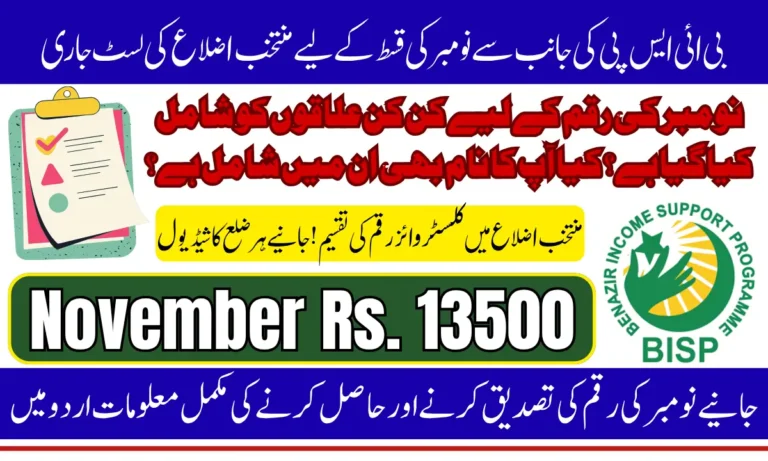
BISP Payment Districts November 2026: The Benazir Income Support Program has officially launched the November 2025 payment round, marking another important milestone in Pakistan’s social welfare efforts. Through this initiative, the government continues its mission to empower low-income women and their families by providing timely financial assistance. Each eligible woman is receiving Rs. 13,500 for this quarter, ensuring continued support for food, education, and health needs.

The November 2026 cycle has introduced several improvements in both payment distribution and withdrawal options. With a stronger digital network, better transparency, and new district-level schedules, beneficiaries can now access their payments with greater convenience and security. The government’s clear priority is to eliminate long queues, reduce fraud, and make sure that no eligible woman misses her entitlement.

Also Read: How To Get CM Punjab Flood Relief Card 2026 After Survey Completion – Full Process & Distribution Details

Overview of the November 2026 Payment Cycle

The current payment cycle reflects the government’s enhanced commitment to providing direct economic assistance to Pakistan’s most vulnerable households. Payments have started in mid-November and will continue through early December 2026, ensuring that all beneficiaries across Punjab, Sindh, Khyber Pakhtunkhwa (KPK), Balochistan, Azad Jammu & Kashmir (AJK), and Gilgit Baltistan (GB) receive their due amount.

Each beneficiary is entitled to Rs. 13,500, which is transferred through partner banks and official BISP camps. Notifications are sent via the verified 8171 SMS service, confirming payment availability. This system helps women plan their collection visits according to their district’s schedule, avoiding unnecessary crowding and delays.

Updated District-Wise Payment Schedule

To manage the distribution efficiently, BISP has divided the disbursement process into district-wise phases. Each province has been assigned specific dates based on operational capacity and banking availability. The following table outlines the expected schedule for November 2026.

District / AreaProvince / RegionStatusExpected Payment Dates
Faisalabad, Muzaffargarh, VehariPunjabActive18 – 25 November 2026
Sanghar, Mirpur Khas, TharparkarSindhOngoing15 – 22 November 2026
Peshawar, Swabi, KohatKPKActive20 – 27 November 2026
Gwadar, Awaran, KhuzdarBalochistanActive22 – 29 November 2026
Diamer, Bagh, KhurmangAJK / GBOngoing24 – 30 November 2026

Beneficiaries in the remaining districts will receive payments by early December. Each district office coordinates with partner banks to ensure cash availability and smooth biometric verification.

Also Read: BISP 8171 Balance Check 2026: Verify Latest Rs.13,500 Payment Online & Offline Before Withdrawal Using CNIC

How to Check BISP Payment Status Using CNIC

One of the most convenient upgrades to the BISP system is the digital payment verification method. Beneficiaries can confirm whether their payment is ready using their Computerized National Identity Card (CNIC). This ensures that only verified and eligible women collect the funds meant for them.

  • Visit the official web portal https://8171.bisp.gov.pk/
  • Enter your 13-digit CNIC number
  • Complete the captcha code and click “Check Eligibility”
  • Your payment status and district details will appear on the screen

If you do not have internet access, you can still check through your mobile phone.

  • Type your 13-digit CNIC number in a message
  • Send it to 8171
  • Wait for a confirmation SMS about your eligibility and payment readiness

These digital tools save time, prevent confusion, and reduce the need for unnecessary travel to offices.

Easier and Safer Withdrawal Options

For November 2026, the withdrawal system has been upgraded to make the process simpler and faster, particularly for women in rural and remote districts. The government has expanded payment options to include partner banks (HBL and Bank Alfalah) and Easypaisa service points. This broader network provides multiple withdrawal locations near beneficiaries’ homes.

Before collecting your payment, ensure that you carry all necessary documents for smooth verification.

  • Original CNIC (computerized national identity card)
  • Registered mobile number in your name
  • Payment SMS or notification from 8171

At the payment center:

  • Complete biometric verification using your thumb
  • Receive a printed slip for confirmation
  • Collect Rs. 13,500 in cash and count it carefully before leaving

No agent or staff member is allowed to charge any service fee. If someone asks for money, immediately report it to the official helpline at 0800-26477.

Also Read: Livestock Card Phase 2 Online Registration Portal Launched Know Complete Application Method

Common Payment Issues and Quick Solutions

Even with an improved system, a few beneficiaries might face temporary issues during collection. Most of these can be resolved quickly if the right steps are followed.

Before reviewing the bullet points, remember that patience and accurate verification play a vital role in successful payment retrieval.

  • No SMS received: Wait for your district’s scheduled dates or check online at 8171.
  • Biometric verification failed: Visit the nearest BISP Tehsil Office for manual approval.
  • CNIC expired: Renew your CNIC from NADRA and resend it to 8171 for reactivation.
  • Payment deducted or missing: Report immediately to the helpline 0800-26477.
  • District not listed: You may receive your payment in the next distribution batch.

By following these steps, beneficiaries can avoid unnecessary delays and make sure they receive their full payment safely.

Safety Guidelines for Beneficiaries

To prevent fraud and ensure safe withdrawals, BISP has introduced strong safety protocols. These guidelines are crucial, especially for first-time recipients or those in rural communities.

Before proceeding to the bullet points, remember that official communication always comes from verified 8171 sources only.

  • Collect cash only from authorized BISP centers or partner bank outlets.
  • Do not share your CNIC, OTP, or payment details with anyone.
  • Never pay any “extra charges” to agents or middlemen.
  • Confirm that your payment message originates from the official 8171 number.
  • Report suspicious behavior or unauthorized deductions immediately.

These safety rules protect beneficiaries from scams and ensure that government aid reaches the right hands without any interference.

Also Read: BISP 8171 November 2026 Payment Schedule, Requirements, And Verification Step-by-Step Guide

CNIC Renewal and Re-Enrollment for Continued Payments

A common reason for delayed or missing payments is an expired CNIC. BISP cannot disburse funds to individuals whose national identity cards are invalid. To keep your payments active, it is essential to renew and verify your CNIC on time.

If your CNIC has expired or your information has changed, follow these quick steps to stay eligible for future payments:

  • Visit the nearest NADRA office and renew your CNIC.
  • Complete biometric verification and ensure all personal details are accurate.
  • Take the renewed CNIC to the BISP Tehsil Office for record updating.
  • Send your CNIC number again to 8171 to reactivate your payment status.

Once verified, your next installment will automatically appear in the system, and you’ll receive an SMS notification confirming availability.

Impact of BISP on Local Communities

The BISP program continues to serve as a cornerstone of Pakistan’s social protection framework. Its focus on women-led households has created lasting economic and social benefits, particularly in low-income districts.

The November 2026 payments contribute not only to immediate relief but also to long-term stability in poor communities. Women are now able to manage household expenses more independently and invest in their children’s education and health.

Some major social outcomes observed through BISP include:

  • Financial independence for women through direct cash transfers.
  • Improved access to basic needs like food, healthcare, and schooling.
  • Stronger local economies due to increased household purchasing power.
  • Reduced exploitation through transparent biometric verification.

These impacts show that BISP is more than just a financial support initiative—it is a tool of empowerment and sustainable poverty reduction.

Also Read: BISP 8171 Web Portal Relaunched Step-By-Step Guide To Check Eligibility And Payment Status Online

Economic Significance of Timely Payments

Timely payments play a critical role in stabilizing vulnerable families, especially during periods of inflation. The government’s consistent payment schedule under BISP helps reduce the uncertainty that low-income households often face.

For many women, the Rs. 13,500 quarterly payment acts as a financial lifeline, allowing them to buy essentials, manage school expenses, and cover healthcare needs without debt. The smooth digital and district-based system has made the process faster and more reliable than ever before.

Final Words

The BISP November 2026 Payment Schedule demonstrates the government’s firm dedication to ensuring that financial assistance reaches every deserving woman across Pakistan. With expanded district coverage, secure withdrawal options, and transparent verification, this program continues to uplift millions of lives.

Beneficiaries are encouraged to stay connected through the official 8171 system, avoid unauthorized intermediaries, and always collect payments from verified centers. Through consistent implementation, BISP remains one of the most impactful social safety initiatives in Pakistan’s history.

Also Read: Breaking News! Government Reduced Rs. 5.66/L Price Of Petrol And Released the New Price list Check Details

FAQs

When will the November 2026 payments be completed?
Payments will continue through November and are expected to conclude by early December 2026.

How much is each beneficiary receiving this month?
Every registered and verified beneficiary will receive Rs. 13,500 for the November 2026 installment.

Where can I check my payment status online?
Visit https://8171.bisp.gov.pk/ and enter your CNIC number to view your status.

What should I do if my biometric verification fails?
Go to the nearest BISP Tehsil Office where staff will assist you with manual verification.

Is there any service fee for collecting payments?
No, all BISP payments are completely free. Any deduction or demand for money should be reported immediately to 0800-26477.


BISP CNIC Reverification 2026: Latest Update, Requirements, and Registration Method

BISP CNIC Reverification 2025: Latest Update, Requirements, and Registration Method

BISP CNIC Reverification 2026

BISP CNIC Reverification 2026: The Benazir Income Support Program has started its 2026 CNIC reverification drive to ensure that all beneficiaries are genuine, eligible, and actively registered in the national database. This verification is crucial for those receiving financial assistance under the Benazir Kafalat Program, which provides Rs. 13,500 quarterly to deserving women and low-income families. The new reverification campaign runs from October 1 to October 31, 2026, aiming to update beneficiary records and remove duplicate or outdated entries.

This initiative is part of the government’s broader effort to maintain transparency, ensure funds reach the right families, and prevent fraud. Beneficiaries who fail to complete the CNIC verification within the stipulated period may face delays or suspension of their payments until their information is confirmed.

Also Read: WAPDA Internship Program 2026 Online Apply For 25000 Monthly Stipend Know Step-By-Step Guide

Why BISP CNIC Reverification 2026 is Important

The CNIC reverification process is more than just an administrative step. Over time, many records become outdated due to expired CNICs, mismatched NADRA data, or incomplete household surveys. By verifying CNICs, the government ensures that all financial aid reaches deserving families without interruptions.

The process also safeguards against fraudulent claims and duplicate registrations. Maintaining a verified and updated database allows the program to function efficiently and ensures that every rupee is delivered to those who genuinely need assistance. This verification also strengthens trust in the BISP system among beneficiaries and authorities alike.

Who Must Complete CNIC Reverification

Not every BISP participant is required to reverify their CNIC, but certain groups must complete the process to remain eligible for financial assistance.

Before and after the following points, beneficiaries who fall under these categories should act promptly:

  • Individuals who registered for BISP in 2026
  • Those who received an official 8171 SMS requesting verification
  • Beneficiaries who recently renewed their CNIC through NADRA
  • Families with mismatched NADRA and BISP data
  • Applicants who have not completed the dynamic household survey
  • Portal users whose status shows “Reverification Required”

Completing the verification within the deadline ensures continued receipt of the Rs. 13,500 payment in the December 2026 cycle.

Also Read: Punjab High-Tech Mechanization Loan Scheme 2026 Up to 30 Million Without Interest On 5-Year Installment Full Details

How to Check BISP CNIC Verification Status

Beneficiaries can check their CNIC status through official online or SMS-based services. These platforms provide a quick, transparent, and free way to confirm eligibility.

Online Method

  • Visit the official portal at https://8171.bisp.gov.pk
  • Enter your CNIC without dashes
  • Complete the CAPTCHA verification
  • Click “Check Status” to see your record
  • The portal will display your payment and verification status

This method is particularly useful for rural areas where traveling to a BISP office may be difficult.

SMS Method

  • Open your mobile messaging app
  • Type your CNIC number without dashes
  • Send it to 8171
  • Wait for the reply from BISP, which confirms your eligibility or provides instructions

This service is available nationwide and works on all mobile networks.

Also Read: CM High-Tech Mechanization Approved Machinery Price List & Suppliers Details 2026

Step-by-Step Guide to Complete CNIC Reverification

Once your CNIC requires reverification, you must follow the official process to ensure your records are updated.

Before and after the points below, remember to use only government-approved offices:

  • Visit the nearest BISP Tehsil Office
  • Bring all required documents including CNIC, B-Form, and utility bill
  • Fill out the verification form with accurate information
  • Complete biometric verification using NADRA’s system
  • Receive a confirmation SMS from 8171

Most beneficiaries can complete this process in a single visit if documents are complete.

Documents Required for CNIC Reverification

Having the correct documents is essential for a smooth verification process. Missing papers can result in repeated visits or delays.

Before and after the points below, ensure you carry originals and photocopies:

  • CNIC of the primary beneficiary
  • B-Form for children, if applicable
  • Latest utility bill for address verification
  • Proof of household income or employment
  • Additional documents required for poverty score verification

Carrying all necessary documents ensures a faster and hassle-free experience.

Also Read: How To Apply Online For CM High Tech Mechanization Loan Scheme 2026 Step-By-Step Method 2026

Common Issues and Their Solutions

Some beneficiaries face technical or documentation challenges during verification. These can usually be resolved quickly with the right approach.

Before and after the points below, follow these solutions:

  • Fingerprint mismatch: Update at NADRA and retry verification
  • Expired CNIC: Renew CNIC before visiting BISP office
  • Data mismatch: Correct NADRA details and reverify
  • No SMS received: Check eligibility via the portal
  • Long queues: Visit early in the morning for faster service

Addressing these issues early helps avoid unnecessary payment delays.

BISP Payment Process After Reverification

Once your CNIC is verified, the next payment cycle proceeds smoothly. Beneficiaries receive an SMS confirming the verification, after which their Rs. 13,500 payment is released.

  • Payments are distributed through partner banks like HBL and Bank Alfalah
  • Authorized BISP payment centers in each district
  • ATMs and BISP retailers with biometric systems

Always verify your payment SMS and avoid unofficial agents to ensure safety.

BISP 2026 Schedule and Deadlines

The government has clearly defined dates for reverification and payments to avoid confusion.

EventDate / Period
Reverification OpensOctober 1, 2026
Last Date for CNIC ReverifyOctober 31, 2026
Data Review and ApprovalNovember 2026
Payment ReleaseDecember 2026 onward

No extensions are provided, so timely action is crucial for uninterrupted payments.

Also Read: CM High Tech Mechanization Loan Scheme 2026 Requirements For Application And Security Details

Tips for Smooth Verification

Following official guidance can simplify the verification process and prevent errors.

Before and after the points below, consider these tips:

  • Begin verification early to avoid last-minute delays
  • Keep your CNIC renewed and active
  • Double-check all information on the form before submission
  • Carry photocopies of important documents
  • Avoid unauthorized agents or middlemen
  • Keep the confirmation SMS as proof of verification

These measures ensure a faster, hassle-free process and continuous financial support.

Benefits of Completing CNIC Reverification

Completing the BISP CNIC reverification has long-term benefits for both beneficiaries and the government.

Before and after the points below, note these advantages:

  • Ensures eligibility for future quarterly payments
  • Prevents fraudulent or duplicate registrations
  • Keeps records updated in the national database
  • Promotes transparency and fairness in the system
  • Guarantees direct financial support to deserving families

Reverification strengthens the overall social protection framework in Pakistan.

Final Words

The BISP CNIC Reverification 2026 campaign is a crucial step for maintaining a transparent, fair, and efficient social support system. Beneficiaries are urged to verify their CNICs before the October 31 deadline to avoid interruptions in the Rs. 13,500 payments.

Using official portals and SMS services ensures secure, accurate, and hassle-free verification. Timely completion not only secures your payment but also contributes to a more accountable welfare system.

Also Read: CM Punjab 30 Million Farmer Loan Scheme For Mechanization Know Repayment Plan And Key Features

FAQs

Is the BISP CNIC reverification process free?
Yes, the process is entirely free. No fees are charged for verification.

Can I verify my CNIC online?
You can check the status online, but physical verification may be required if your record shows “Reverification Required.”

What happens if I ignore the 8171 SMS?
Payments may be delayed or suspended until the verification is completed.

How long does it take to get the payment after verification?
Payments are usually released in the next quarterly cycle following successful verification.

Which documents are mandatory for verification?
CNIC, B-Form for children, utility bill, and proof of household income are required for smooth processing.

CM Punjab High-Tech Farm Mechanization Finance Program 2026 A Complete Informational Guide

CM Punjab High-Tech Farm Mechanization Finance Program 2026 A Complete Informational Guide

CM Punjab High-Tech Farm Mechanization

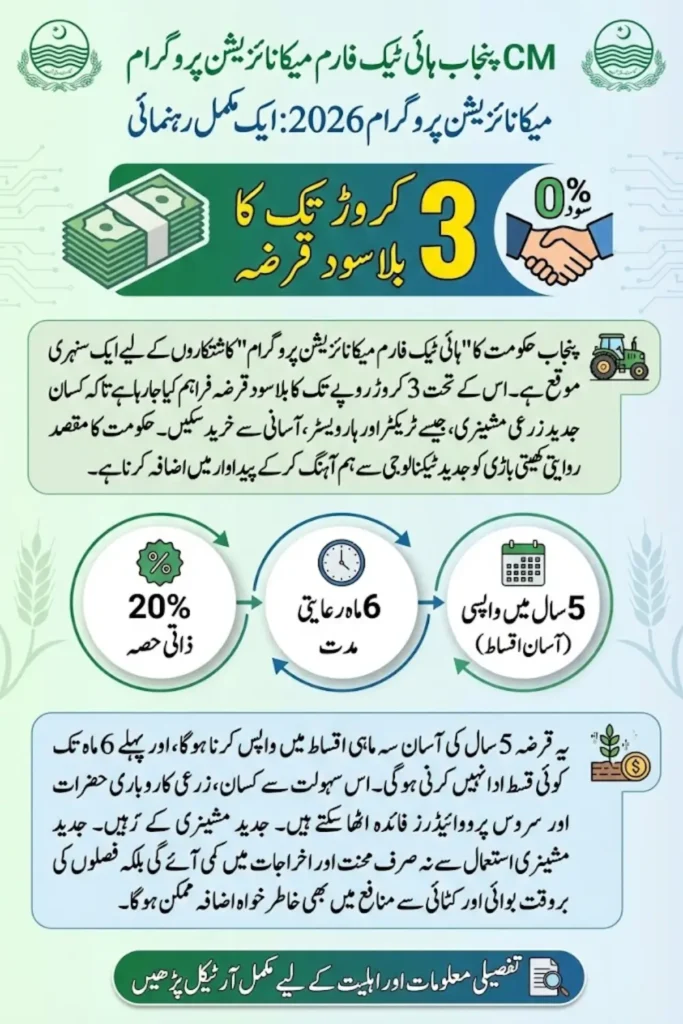
The CM Punjab High-Tech Farm Mechanization Finance Program 2026 is a major step taken by the Punjab Government to transform traditional agriculture into a modern, technology-driven sector. Farming in Punjab has long depended on manual labor and outdated tools, which often results in low productivity, higher costs, and delayed farming operations. This initiative has been introduced to remove those barriers by providing interest-free financial support that allows farmers and agricultural entrepreneurs to invest in modern machinery without facing heavy loan pressure. By encouraging mechanization, the program aims to improve crop yields, reduce labor dependency, and strengthen the rural economy across the province.

پنجاب میں زراعت طویل عرصے سے دیہی معیشت کی بنیاد رہی ہے، مگر بدلتے ہوئے حالات، بڑھتی ہوئی لاگت اور مزدوروں کی کمی نے کسانوں کے لیے جدید طریقے اپنانا ناگزیر بنا دیا ہے۔ انہی ضروریات کو مدنظر رکھتے ہوئے پنجاب حکومت نے سی ایم پنجاب ہائی ٹیک فارم میکانائزیشن فنانس پروگرام 2026 متعارف کروایا ہے، جس کا مقصد کسانوں اور زرعی کاروبار سے وابستہ افراد کو جدید زرعی مشینری تک آسان اور سود سے پاک رسائی فراہم کرنا ہے۔ یہ پروگرام زراعت میں ٹیکنالوجی کے فروغ، پیداواری صلاحیت میں اضافے اور دیہی علاقوں میں معاشی استحکام لانے کی جانب ایک اہم قدم ہے۔

YOU CAN ALSO READ: Punjab Introduces High-Tech Farm Mechanization 2026 to Transform Modern Agriculture

CM Punjab High-Tech Farm Mechanization Finance Program 2026 A Complete Informational Guide

Vision Behind Agricultural Mechanization

The government’s vision is to make farming more efficient, profitable, and sustainable. Modern agricultural machinery helps farmers complete time-sensitive tasks such as planting and harvesting on schedule, which directly impacts crop quality and output. Mechanization also minimizes post-harvest losses and ensures better resource management. Through this program, Punjab is moving toward a future where farming relies more on precision, technology, and skilled operation rather than manual effort alone.

Financing Structure and Loan Framework

The program offers interest-free loans to eligible applicants, with the Punjab Government covering the full interest amount. Beneficiaries are required to repay only the principal amount through quarterly installments spread over several years. A grace period is provided before repayments begin, giving applicants time to put the machinery into use and generate income. This structure significantly reduces financial stress and makes advanced machinery accessible even to those who could not afford it through commercial loans.

Key Financial Terms at a Glance

FeatureDetails
Maximum Loan AmountUp to PKR 30 million
Interest Rate0% (paid by Punjab Government)
Repayment Duration5 years
Installments20 quarterly payments
Grace Period6 months
Equity Contribution20% by applicant
Partner BankBank of Punjab
Processing FeePKR 5,000

YOU CAN ALSO READ: A New Welfare Architecture in Punjab: Understanding the 2026 Poverty Relief Framework

These terms are designed to balance affordability with financial discipline, ensuring the long-term success of the program.

Eligible Participants and Target Groups

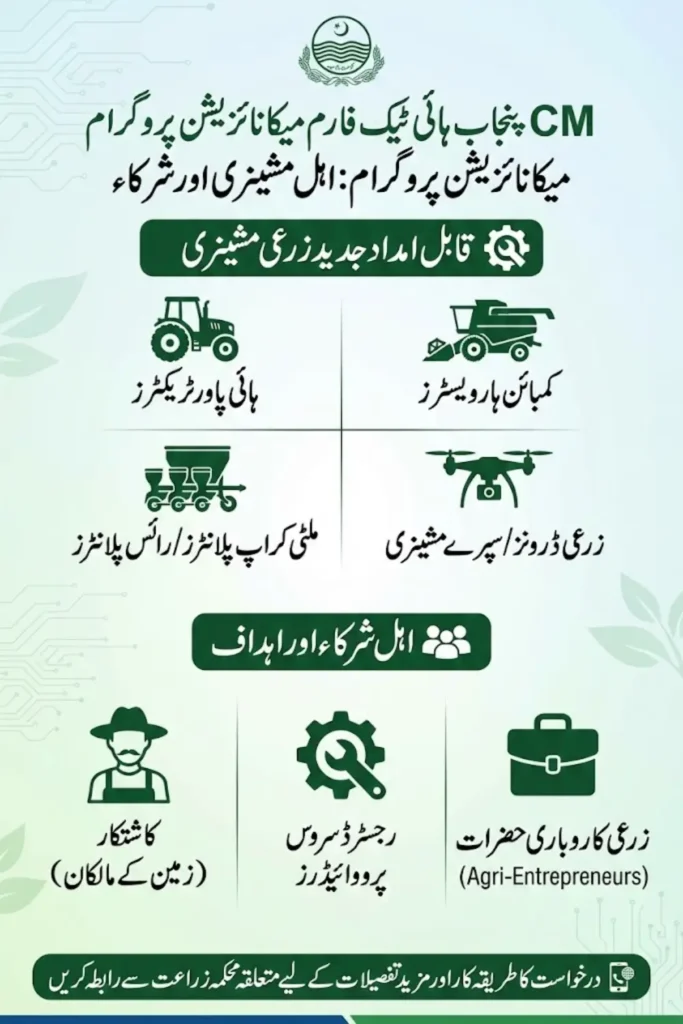
The program is open to multiple categories involved in agriculture. Farmers owning agricultural land can apply to modernize their farming practices. Registered service providers are encouraged to participate so they can offer mechanized services to small and medium farmers. Agri-entrepreneurs with valid business credentials can also apply, promoting innovation and private sector involvement in agriculture. Applicants must fall within a defined age range, hold a valid CNIC, and demonstrate the ability to repay installments responsibly.

Machinery Categories Supported

A wide range of high-tech agricultural machinery is covered under the program to support different farming needs. These include equipment used for land preparation, planting, harvesting, crop protection, and post-harvest handling. Machines such as combine harvesters, multi-crop planters, rice planters, silage harvesters, maize harvesting equipment, orchard sprayers, nursery machines, high-power tractors, and advanced irrigation tools are included. The availability of such equipment allows farmers to improve efficiency across the entire crop cycle.

CM Punjab High-Tech Farm Mechanization Finance Program 2026 A Complete Informational Guide

Application and Approval Process

The application process has been designed to be transparent and user-friendly. Applicants register using their CNIC and mobile number, select their applicant category, and choose machinery from the approved list. Required documents are uploaded for verification before submission. After departmental review, applications are forwarded to the Bank of Punjab for financial assessment. Once approved, the applicant pays the required equity share, and the bank releases funds directly to the machinery supplier.

YOU CAN ALSO READ: NSER CNIC Registration Explained: Who Qualifies for BISP 8171 and How to Apply

Role of Institutional Support

The Bank of Punjab manages loan processing, repayment schedules, and monitoring, while the Punjab Government provides policy support and pays the interest cost. Agriculture department officials also conduct inspections and ensure that machinery is used for productive purposes. This shared responsibility ensures transparency, accountability, and smooth implementation of the program.

Impact on Productivity and Rural Economy

Mechanization plays a critical role in increasing farm productivity and reducing operational delays. With access to modern machinery, farmers can lower production costs, manage labor shortages, and improve crop quality. Service providers create new income streams by offering mechanized services, while rural areas benefit from job creation in machine operation and maintenance. Over time, these improvements contribute to stronger food security and economic stability in Punjab.

YOU CAN ALSO READ: Punjab Agriculture Enters a New Phase as Mechanization Program 2026 Expands Across the Province

Post-Approval Obligations for Beneficiaries

After receiving financing, beneficiaries must comply with specific conditions. Machinery remains under bank hypothecation until full repayment, and periodic inspections are conducted. Training sessions on machine operation and maintenance are mandatory to ensure safe and effective use. Timely repayment of installments is essential to avoid penalties and maintain credibility for future support programs.

Conclusion:

The CM Punjab High-Tech Farm Mechanization Finance Program 2026 represents a practical and forward-thinking approach to agricultural development. By offering interest-free financing, structured repayment plans, and access to advanced machinery, the program empowers farmers and agri-entrepreneurs to adopt modern farming practices. This initiative not only improves productivity at the farm level but also supports rural employment, economic growth, and long-term sustainability. As mechanization spreads across Punjab, the program is expected to play a vital role in building a more efficient, competitive, and resilient agricultural sector.

سی ایم پنجاب ہائی ٹیک فارم میکانائزیشن فنانس پروگرام 2026 نہ صرف کسانوں کو جدید مشینری فراہم کرنے کا ذریعہ ہے بلکہ یہ پنجاب کی زراعت کو ایک مضبوط اور پائیدار مستقبل کی طرف لے جانے کی کوشش بھی ہے۔ سود سے پاک قرضہ، آسان اقساط اور حکومتی نگرانی اس پروگرام کو کسان دوست بناتی ہیں۔ جدید زرعی آلات کے استعمال سے فصلوں کی بہتر پیداوار، لاگت میں کمی اور وقت کی بچت ممکن ہوتی ہے، جو بالآخر دیہی معیشت کو مضبوط بنانے میں مددگار ثابت ہوگی۔ یہ پروگرام پنجاب میں زرعی ترقی اور خود کفالت کی جانب ایک اہم سنگِ میل ثابت ہو سکتا ہے۔

YOU CAN ALSO READ: Ramzan Relief Program 2026: Complete Guide to CNIC Verification, Eligibility, and Assistance

Ramzan Relief Program 2026: Complete Guide to CNIC Verification, Eligibility, and Assistance

Ramzan Relief Program 2026: Complete Guide to CNIC Verification, Eligibility, and Assistance

Ramzan Relief Program

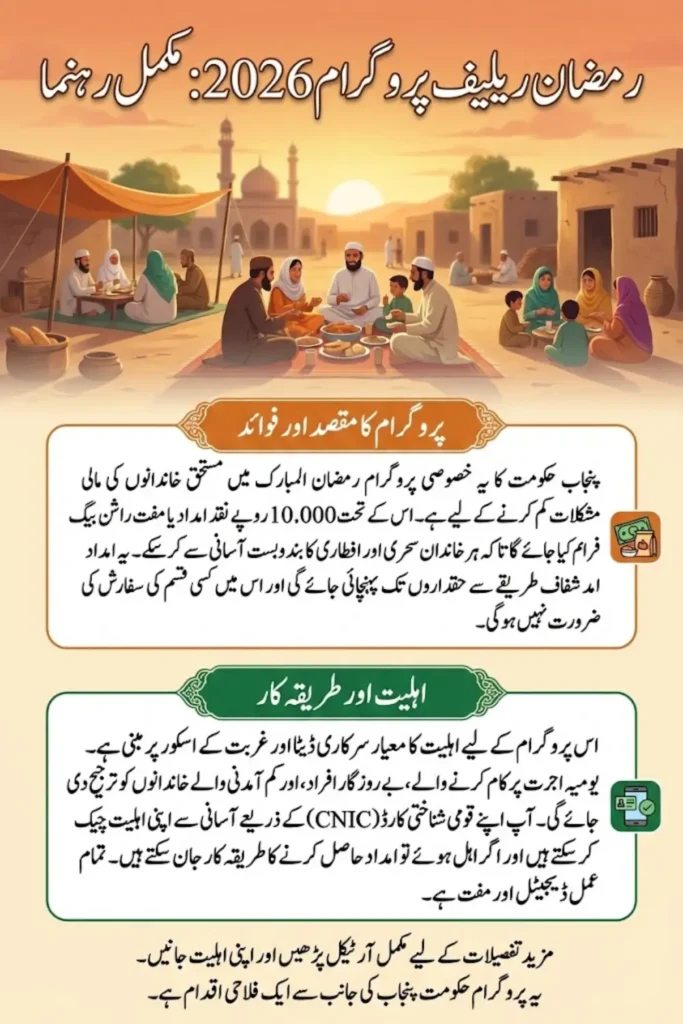
Every year, the holy month of Ramzan Relief Program brings spiritual reflection along with increased household expenses, especially for low-income families. To reduce this financial pressure, the Punjab Government has launched the Ramzan Relief Program 2026, a structured welfare initiative designed to support deserving households through cash assistance and ration support. This program focuses on transparency, dignity, and equal access by using a digital verification system that allows families to confirm their eligibility using their CNIC without relying on agents or office visits.

YOU CAN ALSO READ: Punjab Moves Toward Smarter Farming With Interest-Free Mechanization Support

Purpose Behind the Ramzan Relief Initiative

The core aim of the Ramzan Relief Program is to ensure that financial and food assistance reach families who truly need support during Ramzan. Rising food prices and daily expenses can make it difficult for vulnerable households to manage Sehri and Iftar needs. By introducing a centralized verification system connected with official databases, the government has minimized manual interference and improved fairness in welfare distribution.

Ramzan Relief Program 2026: Complete Guide to CNIC Verification, Eligibility, and Assistance

Digital Verification System Explained

To manage a large number of applicants efficiently, the government uses an online CNIC-based verification process. This system checks an applicant’s details against official socio-economic records, ensuring that eligibility decisions are based on factual data rather than recommendations or influence. Families can view their status instantly, which reduces uncertainty and unnecessary waiting.

Forms of Assistance Available in 2026

The Ramzan Relief Program provides multiple types of assistance depending on a household’s financial condition. Some families qualify for direct cash support, while others receive ration packages containing essential food items. The assistance is designed to cover basic necessities so families can focus on worship without financial stress.

YOU CAN ALSO READ: Punjab Green Tractor Scheme Phase 2: A Game Changer for Small and Medium Farmers

Overview of Available Support

Assistance TypeDescription
Rs. 10,000 Cash SupportFor highly vulnerable and extremely low-income families
Rs. 5,000 Financial AidFor households with limited but stable income
Ramzan Ration PackageIncludes essential food items for daily use
Additional Welfare SupportProvided under specific government criteria

Who Can Qualify for the Program

Eligibility is determined through verified government data. Priority is given to families with low income, daily wage earners, unemployed individuals, widows, and households already registered in socio-economic surveys. Applicants must have a valid CNIC and should not fall into high-income or tax-paying categories. Government employees and individuals with strong financial records are usually excluded unless special conditions apply.

Registration and Data Collection Process

The Ramzan Relief Program does not rely on open applications alone. Instead, most registrations are completed through government surveys and official data collection drives. This method ensures accurate household profiling and prevents duplicate or false entries. Once a family’s data is recorded, it becomes part of the verification system and remains available for future welfare assessments as well.

YOU CAN ALSO READ: Punjab Agriculture Enters a New Phase as Mechanization Program 2026 Expands Across the Province

Checking Eligibility Status Using CNIC

Families can easily check their relief status by entering their CNIC number into the official verification system. The process is simple and does not require any technical skills. After submission, the system displays the applicant’s current status, helping families understand whether they qualify for assistance or if their data is still under review.

Understanding Status Results Clearly

Applicants may see different status messages, each with a specific meaning. An approved status confirms eligibility and indicates that the family will receive assistance soon. If the status shows under verification, it means the data is still being reviewed and requires patience. A not eligible result means the household does not meet the criteria based on available records, while CNIC not found usually points to missing or incorrect registration information.

YOU CAN ALSO READ: Punjab Introduces High-Tech Farm Mechanization 2026 to Transform Modern Agriculture

Distribution of Cash and Ration Support

Once approved, beneficiaries are informed through official communication channels regarding payment collection or ration distribution schedules. Cash assistance is provided through authorized methods, while ration packages are distributed at designated centers. The government aims to make the distribution process organized and respectful so families do not face long waits or confusion.

Common Issues Faced by Applicants

Some families experience delays due to incomplete data, incorrect CNIC entry, or high system traffic. These issues are generally temporary and can be resolved by double-checking CNIC details or waiting for verification updates. Prolonged verification does not automatically mean rejection; it often indicates ongoing data review.

Fraud Awareness and Safety Measures

The government has clearly stated that the Ramzan Relief Program is completely free. No agent, individual, or organization is authorized to charge money for registration or status checking. Families are advised to protect their CNIC information, avoid sharing documents on social media, and trust only official government systems for updates.

YOU CAN ALSO READ: A New Welfare Architecture in Punjab: Understanding the 2026 Poverty Relief Framework

Why This Program Matters for Families

Beyond financial support, the Ramzan Relief Program promotes dignity and peace of mind. By removing middlemen and using digital verification, the government has created a system where families can independently check their eligibility without fear or pressure. This approach strengthens trust in public welfare programs and ensures that assistance reaches those who need it most.

Final Thoughts

The Ramzan Relief Program 2026 reflects a thoughtful approach to welfare distribution during a sacred time of the year. With a transparent eligibility system, multiple assistance options, and a focus on fairness, the program offers meaningful support to deserving households. Families are encouraged to rely on official channels, stay patient during verification, and use the system responsibly to benefit from this important initiative.

YOU CAN ALSO READ: NSER CNIC Registration Explained: Who Qualifies for BISP 8171 and How to Apply

8070 Ramzan Relief Program 2026: How Punjab Digital System Supports Low-Income Families

8070 Ramzan Relief Program 2026: How Punjab Digital System Supports Low-Income Families

8070 Ramzan Relief Program

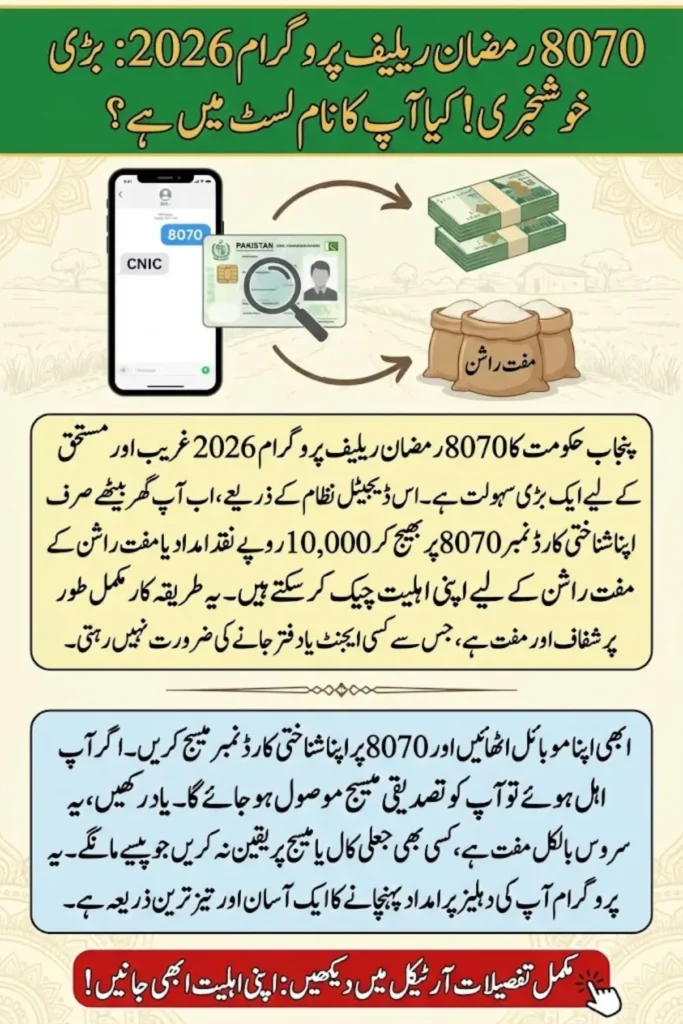
8070 Ramzan Relief Program Punjab Government has introduced the 8070 Web Portal and Ramzan Relief Program 2026 to bring transparency, speed, and ease into welfare distribution. In a time when inflation and rising living costs are putting pressure on low-income households, this digital system allows citizens to check their eligibility for financial assistance and ration support using only their CNIC. The initiative removes confusion, middlemen, and unnecessary office visits by offering a simple online and SMS-based solution.

پنجاب حکومت نے 2026 میں فلاحی نظام کو جدید اور شفاف بنانے کے لیے 8070 ویب پورٹل متعارف کرایا ہے، جس کے ذریعے کم آمدنی والے اور مستحق خاندان صرف اپنا قومی شناختی کارڈ نمبر استعمال کرتے ہوئے یہ جان سکتے ہیں کہ آیا وہ مالی امداد یا رمضان ریلیف کے لیے اہل ہیں یا نہیں۔ مہنگائی اور روزمرہ اخراجات میں مسلسل اضافے کے باعث یہ ڈیجیٹل نظام عوام کے لیے ایک بڑی سہولت بن کر سامنے آیا ہے، کیونکہ اب کسی دفتر کے چکر لگانے، ایجنٹ پر انحصار کرنے یا غیر مصدقہ معلومات پر بھروسہ کرنے کی ضرورت نہیں رہی۔ 8070 پورٹل سرکاری ڈیٹا بیس سے منسلک ہے جو درخواست گزار کی اہلیت، امداد کی نوعیت اور درخواست کی موجودہ صورتحال کے بارے میں درست اور بروقت معلومات فراہم کرتا ہے، جس سے نہ صرف وقت کی بچت ہوتی ہے بلکہ مستحق افراد تک امداد منصفانہ طریقے سے پہنچانے میں بھی مدد ملتی ہے۔

This guide explains how the 8070 system works, who can benefit, what type of assistance is available, and how citizens can avoid common mistakes during the process.

YOU CAN ALSO READ: 8171 Digital Relief Window 2026: CNIC Validation for Family Support Grant

8070 Ramzan Relief Program 2026: How Punjab Digital System Supports Low-Income Families

Purpose of the 8070 Digital Welfare System

The 8070 Web Portal has been developed as a centralized platform to manage multiple welfare schemes launched in Punjab for 2026. It is connected with verified government databases to ensure that only deserving families receive assistance. The main purpose of this system is to provide citizens with real-time information about their application status and approved benefits.

Instead of relying on agents or unofficial sources, applicants can directly check whether they qualify for cash assistance or Ramzan ration support. This digital shift reflects the government’s effort to promote accountability and fair distribution.

Types of Assistance Covered Under 8070

The 8070 system does not manage a single program. It brings together multiple relief initiatives designed for different needs and income levels.

Assistance CategorySupport ProvidedTarget Beneficiaries
Cash Assistance (Qist)Rs. 10,000Extremely low-income Punjab households
Cash Assistance (Qist)Rs. 5,000Eligible low-income families
Ramzan Relief PackageFree or subsidized rationPre-verified deserving families
Other Welfare SupportProgram-based assistanceHealth, education, or emergency cases

Each applicant’s eligibility depends on household data available in government records.

Who Should Use the 8070 Web Portal

The portal is designed for individuals and families who have already registered or participated in any government welfare survey or relief program. It is especially useful for those who have not received confirmation messages but want to verify their status independently.

People who previously applied for cash aid, Ramzan ration packages, or social protection schemes can use this system to confirm whether their application is approved, under review, or rejected.

Step-by-Step Method to Check Status Online

Checking your status through the 8070 Web Portal is simple and does not require any payment or special registration.

First, access the official 8070 portal provided by the Punjab Government. Once the page loads, enter your 13-digit CNIC number carefully without spaces or dashes. After submitting the information, the system will display your eligibility result on the screen.

The entire process usually takes less than a minute and can be done using a mobile phone or computer.

YOU CAN ALSO READ: A New Welfare Architecture in Punjab: Understanding the 2026 Poverty Relief Framework

Understanding Your Eligibility Result

After submitting your CNIC, the system may show different types of responses. Each status has a specific meaning.

If the status shows approved or eligible, it means your household qualifies for assistance and you will receive instructions regarding payment or ration delivery. A status marked under verification indicates that your data is still being reviewed and requires patience. If the result shows not eligible, it means current records do not meet the program’s criteria. In some cases, CNIC not found may appear due to incorrect entry or missing registration data.

8070 Ramzan Relief Program 2026: How Punjab Digital System Supports Low-Income Families

Overview of the 8070 Ramzan Relief Program 2026

The Ramzan Relief Program under the 8070 system has been structured to provide both food security and financial relief during the holy month. The program has been divided into provincial and federal components to ensure wider coverage and better management.

Punjab residents primarily benefit through the provincial segment, while eligible families in other regions receive assistance through the federal channel.

Program SegmentCash SupportRation SupportCoverage Area
Provincial ReliefRs. 10,000Free ration bagPunjab
Federal ReliefRs. 5,000Subsidized rationNationwide

This division allows resources to be distributed more efficiently according to regional needs.

Eligibility Conditions for Ramzan Relief

Eligibility for the Ramzan Relief Program is based on household income, asset ownership, and employment status. Families with low monthly income and valid CNIC records are prioritized. Registration in social welfare databases improves the chances of approval.

Households with government employees in higher grades, ownership of luxury vehicles, or large property holdings are generally excluded to ensure that assistance reaches the most deserving segments.

How to Apply Using SMS Methods

For Punjab residents, the SMS method involves sending the CNIC number to the designated code linked with provincial welfare programs. Applicants receive an automated response confirming eligibility or verification status.

For nationwide assistance under the federal segment, a separate SMS code is used. Both methods are free of cost and do not require visiting any office.

YOU CAN ALSO READ: Punjab Rs. 3,000 Monthly Food Support Plan 2026: How the New Ration Card Is Changing Household Survival

Common Issues and Practical Solutions

Many applicants face problems due to incorrect CNIC entry, slow website access, or delayed verification. Re-checking the CNIC number and trying during non-peak hours often resolves technical issues. Verification delays are common during high application volume and usually resolve within a few weeks.

Citizens should remain cautious of fake messages or individuals asking for money, as all services related to the 8070 system are completely free.

Why the 8070 System Is Important in 2026

The 8070 Web Portal and Ramzan Relief Program represent a shift toward digital governance and citizen empowerment. By combining cash assistance with ration support, the program addresses both immediate financial needs and food security.

This system helps families focus on daily life and religious obligations during Ramzan without the added stress of rising expenses. It also strengthens public trust by ensuring fairness and transparency in welfare distribution.

Final Thoughts

The 8070 Web Portal and Ramzan Relief Program 2026 provide a reliable and transparent way for deserving families to access government support. By using a CNIC-based digital system, the government has reduced dependency on agents and eliminated unnecessary hurdles. For low-income households, this initiative is not just financial help but a step toward dignity, stability, and inclusion during challenging economic times.

YOU CAN ALSO READ: Punjab Introduces High-Tech Farm Mechanization 2026 to Transform Modern Agriculture

آخر میں یہ کہا جا سکتا ہے کہ 8070 ویب پورٹل اور رمضان ریلیف پروگرام 2026 پنجاب حکومت کی ایک مؤثر اور عوام دوست کاوش ہے، جس کا مقصد مستحق خاندانوں تک امداد کو شفاف، باعزت اور آسان طریقے سے پہنچانا ہے۔ ڈیجیٹل نظام کے ذریعے قومی شناختی کارڈ پر مبنی جانچ نے غلط معلومات، دھوکہ دہی اور غیر ضروری تاخیر کو کم کیا ہے، جس سے عوام کا اعتماد سرکاری فلاحی پروگراموں پر مزید مضبوط ہوا ہے۔ موجودہ معاشی حالات میں یہ سہولت کم آمدنی والے گھرانوں کے لیے ایک حقیقی سہارا ثابت ہو رہی ہے، کیونکہ اس کے ذریعے نہ صرف مالی مدد بلکہ رمضان کے دوران بنیادی ضروریات کی فراہمی بھی یقینی بنائی جا رہی ہے، جو ایک منصفانہ اور ذمہ دار حکومتی نظام کی عکاسی کرتی ہے۔

BISP 8171 Balance Check 2026: Verify Latest Rs.13,500 Payment Online & Offline Before Withdrawal Using CNIC

BISP 8171 Balance Check 2025: Verify Latest Rs.13,500 Payment Online & Offline Before Withdrawal Using CNIC

BISP 8171 Balance Check 2026

BISP 8171 Balance Check 2026: Check your BISP 8171 balance for 2026 online or via SMS using CNIC. Verify your 13,500 BISP payment status before withdrawing safely. In 2026, thousands of beneficiaries continue to rely on the 13,500 quarterly installment to cover essential household needs such as food, healthcare, and education. To ensure complete transparency and easy access, the government has introduced advanced online and offline systems for beneficiaries to check their payment status before visiting collection points.

By verifying your BISP 8171 balance in advance, you can avoid unnecessary travel, prevent fraud, and make sure that you receive your full entitlement without any deductions. This process not only saves time but also helps maintain fairness and efficiency across all regions.

Also Read: Livestock Card Phase 2 Online Registration Portal Launched: Know Complete Application Method

Importance of Checking Your Balance Before Withdrawal

Before collecting your Rs. 13,500 installment, it’s crucial to confirm that your payment has been released. Many people travel long distances only to discover that their payment is still in process. Checking your balance before withdrawal prevents such inconvenience and allows you to plan your visit efficiently.

  • Confirm if your Rs. 13,500 installment has been released or is pending
  • Avoid wasting time and travel expenses
  • Protect yourself from scams and unauthorized deductions
  • Plan your visit according to the payment release schedule
  • Ensure a smooth and transparent collection process

Taking these simple steps helps you stay informed and secure while receiving your payment with peace of mind.

Overview of the 8171 Web Portal

The BISP 8171 Web Portal is a digital service launched by the Government of Pakistan to provide easy access to payment information. Through this platform, beneficiaries can check their eligibility, view payment status, and track their transaction history using their CNIC number. This online method has replaced time-consuming physical visits and outdated SMS-based updates.

This service has significantly improved transparency and convenience. Now, beneficiaries can verify their Rs.13,500 payment from home without waiting in long queues or relying on intermediaries. The system works in real time and ensures every eligible person can confirm their payment details accurately.

Features of the 8171 Web Portal include:

  • Real-time payment verification using CNIC
  • Complete transaction and payment history
  • Instant eligibility confirmation for active beneficiaries
  • User-friendly interface accessible through mobile and desktop
  • Reduced chances of misinformation and fraud

With this web portal, the government has strengthened the connection between technology and social welfare, ensuring that financial aid reaches the right people efficiently.

Also Read: BISP 8171 November 2026 Payment Schedule, Requirements, And Verification Step-by-Step Guide

How to Check BISP 8171 Balance Online Using CNIC

Checking your balance online through the 8171 Web Portal is the most efficient and secure method. The process is simple and designed for all beneficiaries, regardless of their location or technical skills. You only need a valid CNIC and internet access to verify your status.

To check your balance online, follow these steps carefully:

  • Open the official 8171 Web Portal in your browser
  • Enter your 13-digit CNIC number correctly
  • Complete the CAPTCHA verification
  • Click the “Submit” button to view your payment details
  • Note the payment status and amount displayed on the screen

Below is a table explaining different payment messages and their meanings to help you understand your result easily:

MessageMeaningAction to Take
PaidPayment has been releasedVisit nearest collection center or ATM
PendingPayment still processingRecheck after a few days
Not EligibleCNIC not in beneficiary listVisit nearest BISP office for updates
Biometric RequiredVerification neededComplete biometric at payment center
Deduction/PartialPayment not received fullyFile complaint through helpline

Understanding these statuses ensures that you know exactly when to collect your payment and what to do if an issue arises.

Also Read: 8171 Check Online CNIC 2026 BISP Payment Online And Full Guide Registration Guide For Ineligible Women

How to Check BISP 8171 Balance Offline

For people who don’t have internet access, the government has introduced offline methods to make the process inclusive. These options are ideal for beneficiaries living in remote or rural areas. By using any of these methods, you can confirm your payment status without needing a smartphone or computer.

Offline balance verification methods include:

  • SMS Method: Send your CNIC number (without dashes) to 8171 and wait for a reply containing your payment status.
  • Helpline Service: Call the BISP helpline at 0800-26477 to confirm your eligibility and payment details.
  • BISP Tehsil Office Visit: Bring your CNIC card to your nearest BISP office to receive payment assistance and updates.

These offline systems ensure that every eligible citizen, regardless of digital literacy, can access payment information quickly and safely.

Also Read: BISP 8171 Web Portal Relaunched Step-By-Step Guide To Check Eligibility And Payment Status Online

Payment Verification and Collection Process

Once you confirm that your status shows “Paid,” you can proceed to withdraw your Rs.13,500 from any authorized BISP payment center, HBL Connect shop, or partner ATM. Before withdrawing, ensure that your biometric verification is completed successfully.

At collection points, always stay cautious. Some agents may attempt to deduct a portion of your payment illegally. Remember, the payment is free of any service charges, and you are entitled to receive the full amount.

Follow these essential steps for safe payment collection:

  • Confirm your payment status before visiting the center
  • Carry your original CNIC card
  • Complete biometric verification properly
  • Count your cash before leaving the counter
  • Collect and keep your printed or SMS receipt

These practices ensure transparency and protect your money from unauthorized deductions.

Also Read: Breaking News! Government Reduced Rs. 5.66/L Price Of Petrol And Released the New Price list Check Details

Reporting Payment Issues or Deductions

If you face any payment-related issue such as delay, deduction, or technical error, you can immediately report it to BISP authorities. The government has established multiple complaint channels to ensure that beneficiaries receive prompt support.

To report a complaint, send your CNIC number followed by the word “Complaint” to 8171. You may also call the helpline at 0800-26477 or visit your nearest BISP office with your CNIC and receipt. This helps officials trace your record and resolve the issue quickly.

Documents required when reporting a problem include:

  • Original CNIC card
  • Payment receipt or screenshot from the 8171 portal
  • SMS confirmation message (if received)

These documents help verify your claim and speed up the resolution process effectively.

Fraud Prevention and Safety Guidelines

Fraud prevention is a top priority under the BISP system. Unfortunately, some fake agents exploit unaware beneficiaries by demanding illegal fees or collecting CNIC data for misuse. It’s important to remain alert and only follow official procedures.

Always collect your payment directly from authorized centers or ATMs. Never share your CNIC or fingerprint with anyone other than an official representative. Keep all your receipts as proof in case of disputes.

Follow these safety guidelines to protect your funds:

  • Never pay anyone for registration or collection assistance
  • Keep your CNIC and OTP secure
  • Verify the authenticity of agents before any transaction
  • Avoid sharing personal information with strangers
  • Always collect payment receipts for record keeping

These steps will help you safeguard your financial support and avoid scams effectively.

Also Read: Chief Minister Punjab Hi Tech Farm Mechanization Finance Program For 30 Million Loan To Farmers Full Detail

What to Do If Your CNIC Shows “Not Eligible”

If your CNIC appears as “Not Eligible” on the 8171 portal, it means your record needs to be updated. This could happen if your CNIC is expired, your family record is incomplete, or your income information needs revision.

To resolve this, visit your nearest BISP Tehsil Office and bring the following documents for verification:

  • Valid CNIC card
  • Family registration certificate issued by NADRA
  • Proof of income or any supporting document
  • Active mobile number for future updates

After completing the verification process, you can check your status again online within a few days to confirm your eligibility for future installments.

Also Read: BISP CNIC Reverification 2026: Latest Update, Requirements, and Registration Method

Quick Checklist Before Withdrawal

Before visiting the payment center, it’s wise to prepare in advance to ensure a smooth and secure process. Proper preparation can save you time and prevent any last-minute issues.

  • CNIC card is valid and not expired
  • Payment status confirmed through 8171 portal or SMS
  • Biometric verification ready and accurate
  • Payment receipt collected after withdrawal
  • No unauthorized deductions during payment

Following this checklist ensures that your visit to the payment center is successful and stress-free.

Final Words

The BISP 8171 Balance Check 2026 system represents a major step toward transparency and digital inclusion in Pakistan’s social welfare structure. By using online and offline verification methods, beneficiaries can easily confirm their Rs.13,500 payments without relying on third parties or facing unnecessary delays.

This initiative empowers families to take control of their finances and promotes accountability at every stage. Checking your balance before withdrawal is not just convenient—it’s the smartest way to ensure that you receive the full support you deserve.

Also Read: cmhightech.punjab.gov.pk Registration And Login Method 2026 For Maryam Nawaz 30 Loan Scheme

FAQs

How can I check my BISP balance online?
Visit the official 8171 portal, enter your CNIC, and view your payment status instantly.

Can I check my balance without the internet?
Yes, send your CNIC number to 8171 via SMS or call the helpline at 0800-26477.

What should I do if my payment shows as pending?
Wait a few days and check again, as payments are released in phases.

Is biometric verification mandatory?
Yes, biometric verification is required for all beneficiaries before cash collection.

What if someone tries to deduct my payment?
Immediately report the issue through the BISP helpline or by sending a complaint SMS to 8171.

BISP Benazir Kafaalat Rs. 13,500 Payment Schedule 2026 Full Update

BISP Benazir Kafaalat Rs. 13,500 Payment Schedule 2026 Full Update

BISP Benazir Kafaalat

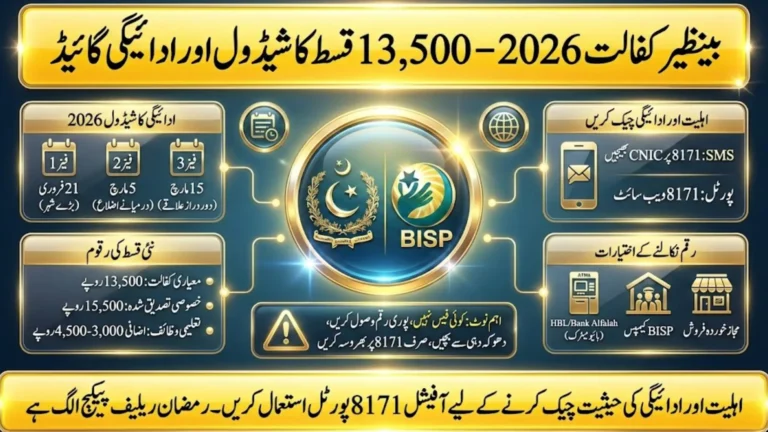
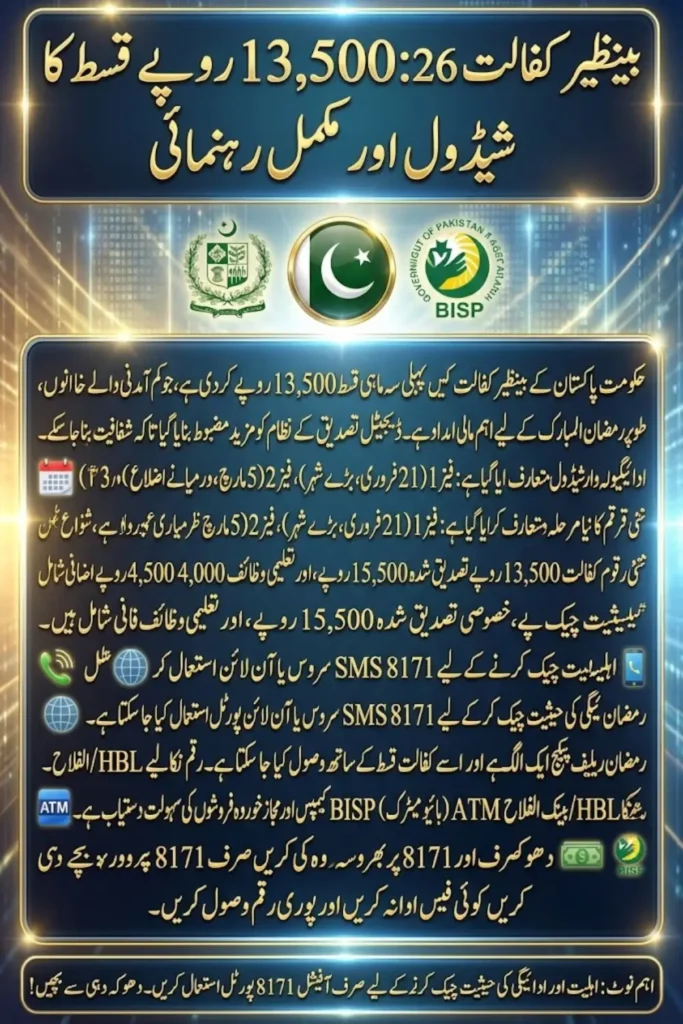
The Government of Pakistan has launched the first quarterly BISP Benazir Kafaalat installment of Rs. 13,500 for 2026, offering crucial financial support to low-income families. This initiative is particularly important as the holy month of Ramadan approaches, helping millions manage household expenses. Beneficiaries can now check their eligibility and payment status through the official 8171 portal from home, reducing the need to visit payment centers.

In 2026, BISP has also strengthened digital verification mechanisms to ensure that the stipend reaches only eligible households. The updated system prevents fraudulent claims and unauthorized deductions, making the process more transparent and efficient.

Updated Installment Schedule for 2026

The government has introduced a district-wise phased payment system to avoid congestion at payment points. This method ensures smooth disbursement for both urban and rural areas, covering all provinces.

YOU CAN ALSO READ: Ramzan 2026 Family Support Cash Program: Apply Online and Receive Funds Fast

BISP Benazir Kafaalat Rs. 13,500 Payment Schedule 2026 Full Update

Payments will continue throughout Ramadan, reaching an estimated 9.3 million beneficiaries nationwide. Families can plan withdrawals according to the following timeline:

Payment Timeline Table:

PhaseStart DateCoverage Area
Phase 1February 21, 2026Major cities: Lahore, Karachi, Peshawar, Quetta
Phase 2March 5, 2026Mid-sized districts & rural hubs
Phase 3March 15, 2026Remaining tehsils & remote regions

Key Points:

  • Phased release reduces overcrowding.
  • Payments are spread across the entire month of Ramadan.
  • Beneficiaries in remote areas receive special arrangements.

New Payment Amounts How Much Will You Receive?

The standard quarterly stipend has been increased in 2026 to help families cope with inflation. The total amount varies depending on the category and region of the household.

Installment Amount Table:

CategoryMonthly EquivalentQuarterly Payment
Standard KafaalatRs. 4,500Rs. 13,500
Special Verified (Remote)Rs. 5,166Rs. 15,500
Educational WazaifVariableAdditional Rs. 3,000–4,500

YOU CAN ALSO READ: 8070 Ramzan Package Online Registration, CNIC Check & Rs 10,000 Payment Details 2026

Important Notes:

  • Any payment above Rs. 13,500 includes Benazir Taleemi Wazaif for school-going children.
  • Special verified households in remote areas receive higher stipends.
  • Educational wazaif payments are in addition to the standard installment.

How to Verify Your Payment Status

Checking your payment is simple and can be done without leaving home. BISP provides two reliable methods:

1. SMS Method:

  • Open your mobile SMS application.
  • Type your 13-digit CNIC number (without spaces or dashes).
  • Send it to 8171.
  • You will receive a reply showing your eligibility and installment status.

2. Online Portal Method:

  • Visit the official 8171 BISP Web Portal.
  • Enter your CNIC number and the captcha code.
  • Click “Check Eligibility” to see detailed payment information.

Points to Remember:

  • Always use the official 8171 portal for accurate information.
  • Avoid third-party apps or WhatsApp messages claiming to provide updates.
  • Keep your CNIC number handy for verification.

YOU CAN ALSO READ: Wazir-e-Azam Relief Package Complete Registration Process & Latest Payment Update 2026

Ramadan Relief 2026 Is It Separate?

Beneficiaries often ask whether the Ramadan Relief Package is included in the Kafaalat installment. The answer is no. Both are distinct programs designed to support families in different ways.

Comparison Table:

ProgramAmountPurpose
Kafaalat InstallmentRs. 13,500Regular quarterly support for basic needs
PM Ramadan PackageRs. 2,000–3,000 or subsidized rashanFederal relief during Ramadan
CM Punjab Nigehban CardRs. 10,000 or rashan hamperProvincial support for Punjab residents

Key Points:

  • Families can receive both Kafaalat and Ramadan relief simultaneously.
  • The Ramadan relief is often distributed through local camps or card-based systems.
  • This ensures vulnerable households get maximum support during the holy month.

Withdrawal Options in 2026

BISP has partnered with banks and authorized retailers to make withdrawals quick and convenient. Both urban and remote households can access their payments safely.

Withdrawal Options Table:

MethodDetails
HBL ATMsBiometric thumb verification
Bank Alfalah (Selected Areas)Biometric-enabled withdrawal
BISP CampsitesTehsil-level access points
Authorized RetailersLocal market shops partnered with BISP

YOU CAN ALSO READ: 8171 Program New Update Announced: Check Eligibility, Complete Survey & Confirm Your Payment Status

Steps for Biometric Withdrawal:

  1. Select BISP/Kafaalat on the ATM.
  2. Enter your CNIC.
  3. Place your thumb on the biometric scanner.
  4. Collect the exact payment amount.

Points to Remember:

  • No fees are required for withdrawal.
  • Always check that the full stipend is received.
  • Report any deduction via the BISP helpline 0800-26477.

Common Reasons for Payment Delays

Sometimes, your payment may show “Under Verification” or “Ineligible” on 8171. This can happen due to multiple reasons:

Reasons Table:

ReasonDescription
Dynamic Survey PendingBeneficiaries must update NSER data every 3 years
Biometric MismatchHousehold income may exceed the eligibility threshold
PMT Score ChangeHousehold income may exceed eligibility threshold

Tips to Avoid Delays:

  • Keep your NSER profile up to date.
  • Visit NADRA if your biometric details are outdated.
  • Confirm your eligibility before visiting payment points.

YOU CAN ALSO READ: BISP Launches Digital Dashboard to Monitor Benazir Nashonuma Program and Tackle Child Malnutrition Across Pakistan

Tips to Protect Your Payment

Protecting your Kafaalat installment is crucial to avoid fraud. Follow these safety measures:

  • Official Communication Only: Only trust messages from 8171.
  • No Registration Fees: BISP services are free of cost.
  • Check Full Amount: Ensure the teller provides the full stipend.

Safety Points:

  • Never share your CNIC or OTP with anyone.
  • Report suspicious agents or deductions immediately.
  • Keep your contact details updated with BISP for SMS alerts.

FAQs

Q1: Can I register for BISP online in March 2026?
Yes, new applicants can register online or at local BISP centers with a valid CNIC and required documents.

Q2: How do I know if I am eligible for the Special Verified category?
This category is for households in remote or high-priority areas, verified via BISP surveys.

Q3: Can I receive both the Benazir Kafaalat installment and PM Ramadan relief?
Yes, both are separate programs, and eligible families can receive both payments simultaneously.

YOU CAN ALSO READ: PSER Registration Open for Punjab Ration Card Monthly Grocery Support Program Details

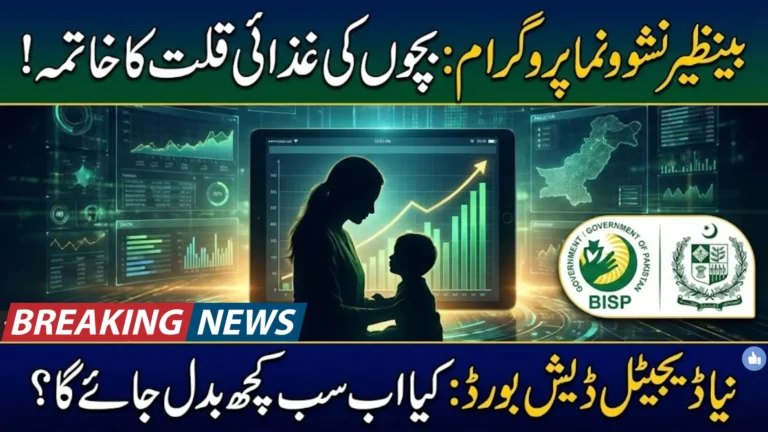
BISP Launches Digital Dashboard to Monitor Benazir Nashonuma Program and Tackle Child Malnutrition Across Pakistan

BISP Launches Digital Dashboard to Monitor Benazir Nashonuma Program and Tackle Child Malnutrition Across Pakistan

BISP Launches Digital Dashboard

BISP Launches Digital Dashboard. Pakistan continues to face serious challenges related to child malnutrition and maternal health. In response, the Benazir Income Support Programme (BISP) has introduced a powerful digital dashboard to closely monitor the Benazir Nashonuma Programme across the country. This new system is designed to improve transparency, strengthen performance tracking, and ensure that financial and nutritional support reaches the families who need it most.

The launch of this dashboard marks an important step toward modernizing social welfare management in Pakistan. By using real-time data and centralized reporting, authorities can now make faster and more informed decisions to combat child stunting and malnutrition.

YOU CAN ALSO READ: How to Verify 8070 Ramzan Package Payment Online Status Check & Registration

BISP Launches Digital Dashboard to Monitor Benazir Nashonuma Program and Tackle Child Malnutrition Across Pakistan

Understanding the Benazir Nashonuma Program

The Benazir Nashonuma Program was created to address malnutrition among pregnant women, lactating mothers, and children under two years of age. It operates under BISP and focuses on preventing stunting during the critical first 1,000 days of a child’s life.

The program provides:

  • Conditional cash transfers to eligible mothers
  • Special nutritious food supplements
  • Regular health check-ups
  • Growth monitoring for infants
  • Health awareness sessions

The goal is simple but urgent: reduce stunting rates and improve long-term health outcomes for children in vulnerable families.

Why a Digital Dashboard Was Needed

Managing a nationwide nutrition program without real-time monitoring can lead to delays, reporting gaps, and inefficiencies. Previously, much of the data collection relied on manual reporting or fragmented systems.

This created challenges such as:

  • Delayed updates on beneficiary enrollment
  • Difficulty tracking attendance at health centers
  • Limited visibility into regional performance
  • Slow identification of underperforming districts

The new digital dashboard addresses these issues by consolidating data from across provinces into a single, structured platform.

Key Features of the Digital Dashboard

The dashboard is not just a reporting tool. It is a comprehensive monitoring system built to improve operational control and policy decisions.

YOU CAN ALSO READ: Suzuki Cultus 2026 Pakistan Price, Specs, Mileage & Top Variants Guide

Below is a breakdown of its core features:

FeaturePurposeBenefit
Real-Time Data UpdatesTracks enrollment and attendance instantlyFaster decision-making
District-Level MonitoringDisplays performance by regionIdentifies gaps quickly
Beneficiary TrackingMonitors individual participationReduces duplication
Growth Monitoring ReportsTracks child height and weight trendsEarly detection of stunting
Payment TrackingVerifies cash transfer disbursementImproves transparency

This structured visibility allows program managers to act quickly instead of waiting for monthly summaries.

How the Dashboard Improves Accountability

One of the strongest advantages of digital systems is accountability. Every data entry, update, and report is logged and traceable.

With the new dashboard:

  • Field staff performance can be reviewed more accurately
  • Attendance at Nashonuma centers is verified digitally
  • Payment release status can be monitored centrally
  • Provincial authorities can compare district progress

This reduces the risk of errors and strengthens oversight mechanisms at every level.

YOU CAN ALSO READ: Maryam Ko Bataye Web Portal 2026: Online Registration & Rs 10,000 Ramadan Support

How Data is Collected and Updated

The dashboard collects data directly from Nashonuma centers and partner health facilities. Trained staff use digital devices to upload information into the centralized system.

Here is how the process works step-by-step:

  1. A beneficiary registers at a Nashonuma center.
  2. Her CNIC and family information are verified through BISP records.
  3. Health indicators such as weight and pregnancy status are recorded.
  4. Data is uploaded into the digital system.
  5. The dashboard updates automatically for district and national review.

This ensures that information is not only recorded but actively monitored.

Impact on Child Malnutrition Strategy

Child malnutrition remains a major concern in Pakistan. According to national health surveys, stunting affects a significant percentage of children under five, especially in low-income households.

The dashboard strengthens the strategy in three main ways:

  • Early Detection: Abnormal growth trends can be flagged quickly.
  • Targeted Intervention: Underperforming regions receive focused support.
  • Data-Driven Policy: Policymakers rely on real-time evidence instead of outdated reports.

This shifts the program from reactive management to proactive planning.

YOU CAN ALSO READ: Maryam Ko Batain Rs 10,000 2026: Your Complete Guide to Fast and Secure JazzCash Payment

Provincial and District-Level Monitoring

The dashboard provides layered access. Federal authorities see nationwide data, while provincial teams access region-specific insights.

District-level monitoring includes:

  • Number of registered beneficiaries
  • Attendance rates at health sessions
  • Nutritional supplement distribution
  • Growth improvement statistics
  • Payment disbursement records

This granular structure ensures that local issues do not remain hidden within national averages.

Benefits for Beneficiaries

While the dashboard is an administrative tool, its ultimate purpose is to serve families more effectively.

Here is how beneficiaries benefit indirectly:

  • Faster resolution of payment delays
  • Improved follow-up on missed health visits
  • Better tracking of child growth
  • Reduced risk of registration duplication
  • Increased transparency in program delivery

When monitoring improves, service quality naturally follows.

YOU CAN ALSO READ: Ramzan 2026 Family Support Cash Program: Apply Online and Receive Funds Fast

Integration with Existing BISP Systems

The digital dashboard is designed to integrate with existing BISP databases, including beneficiary records and payment systems.

This integration allows:

  • Automatic CNIC verification
  • Cross-checking eligibility status
  • Synchronization with payment release mechanisms
  • Real-time reconciliation of records

Instead of operating as a standalone platform, it strengthens the entire BISP ecosystem.

Challenges and Implementation Considerations

Introducing a digital system nationwide comes with challenges. Infrastructure limitations in remote areas and staff training requirements must be addressed carefully.

Key implementation factors include:

  • Ensuring stable internet access in rural districts
  • Training field staff on data entry accuracy
  • Maintaining data security and privacy standards
  • Regular system audits to prevent manipulation

Sustained technical support will be essential for long-term success.

YOU CAN ALSO READ: 8070 Ramzan Package Online Registration, CNIC Check & Rs 10,000 Payment Details 2026

Role of Technology in Social Protection Programs

The launch of this dashboard reflects a broader shift toward digital governance in Pakistan’s social protection sector.

Modern welfare programs now rely on:

  • Centralized databases
  • Biometric verification systems
  • Digital payment transfers
  • Real-time analytics

This transformation reduces administrative costs and improves service delivery efficiency.

Expected Long-Term Outcomes

If implemented effectively, the dashboard could significantly strengthen the fight against child malnutrition.

Expected long-term improvements include:

  • Reduced stunting rates
  • Better maternal health outcomes
  • Improved targeting of high-risk communities
  • Stronger transparency in public spending
  • More accurate national nutrition data

Over time, this data-driven model can serve as a foundation for other health and welfare initiatives.

How This Initiative Supports National Development Goals

Addressing child malnutrition is not only a health priority; it is also an economic and developmental necessity. Stunted children often face cognitive challenges, lower educational performance, and reduced productivity in adulthood.

By improving nutrition monitoring:

  • Human capital development strengthens
  • Healthcare costs decrease
  • Poverty cycles can be disrupted
  • National productivity improves

The dashboard, therefore, supports broader social and economic stability.

YOU CAN ALSO READ: Wazir-e-Azam Relief Package Complete Registration Process & Latest Payment Update 2026

What This Means for the Future of Welfare Monitoring

The introduction of a digital monitoring platform signals a new era of accountability in public welfare programs.

If this model proves successful, similar dashboards could be adopted for:

  • Education assistance programs
  • Cash transfer schemes
  • Health insurance initiatives
  • Food subsidy distribution systems

Digital oversight is gradually becoming the standard rather than the exception.

Conclusion

The launch of the digital dashboard for the Benazir Nashonuma Program represents a significant advancement in Pakistan’s fight against child malnutrition. By centralizing real-time data, strengthening accountability, and enabling district-level performance tracking, BISP has introduced a practical and modern solution to a long-standing challenge.

This system goes beyond simple data collection. It empowers policymakers with accurate information, supports field staff with structured monitoring tools, and ultimately improves services for vulnerable mothers and children.

If managed effectively, the dashboard can transform how social protection programs operate in Pakistan. More importantly, it brings the country one step closer to ensuring that every child has a healthier start to life backed not just by policy promises, but by measurable, transparent action.

YOU CAN ALSO READ: 8171 Program New Update Announced: Check Eligibility, Complete Survey & Confirm Your Payment Status

8171 Program New Update Announced: Check Eligibility, Complete Survey & Confirm Your Payment Status

8171 Program New Update Announced: Check Eligibility, Complete Survey & Confirm Your Payment Status

8171 Program New Update Announced

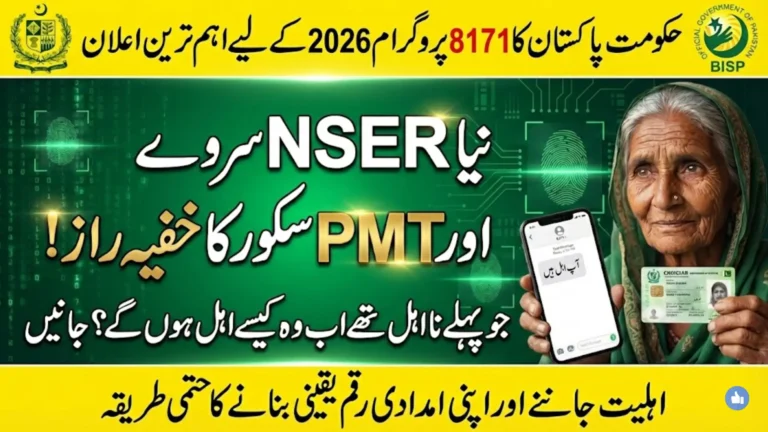
The 8171 Program New Update Announced for 2026 has continued under the supervision of the Benazir Income Support Programme to ensure that financially vulnerable households across Pakistan remain properly identified and supported through a transparent and data-based system. With rising living expenses and economic pressure on low-income communities, the government is focusing on updating household records through the National Socio-Economic Registry (NSER) survey so that only genuinely deserving families are included in the assistance framework. This phase is not a new program but a structured continuation and data verification cycle designed to review existing beneficiaries and register newly eligible households whose financial conditions may have changed.

YOU CAN ALSO READ: Maryam Ko Bataye Web Portal 2026: Online Registration & Rs 10,000 Ramadan Support

Why 8171 Registration Is Important in 2026

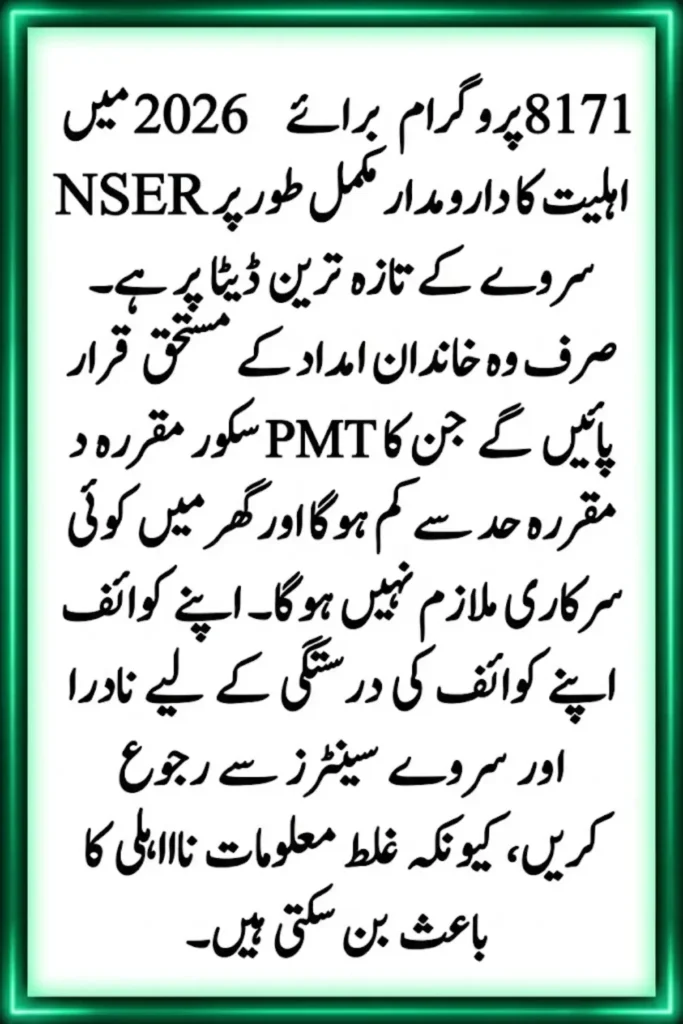
Accurate data is the foundation of fair financial assistance. The 2026 update emphasizes fresh household surveys, correct CNIC records, and proper poverty assessment to prevent duplication and ineligible enrollments. Many families who were previously marked ineligible may now qualify if their financial situation has worsened, while those whose economic condition has improved may be reassessed according to the Poverty Means Test (PMT) score system. This score is calculated based on income level, family size, housing condition, and asset ownership.

8171 Program New Update Announced: Check Eligibility, Complete Survey & Confirm Your Payment Status

The goal is simple: assistance must reach households living below the official poverty threshold without political influence or manual selection.

YOU CAN ALSO READ: Maryam Ko Batain Rs 10,000 2026: Your Complete Guide to Fast and Secure JazzCash Payment

Eligibility Criteria for 8171 Assistance

Eligibility is determined through verified data rather than recommendations. Applicants must:

  • Be a Pakistani citizen with a valid CNIC
  • Complete or update the NSER survey
  • Fall below the official PMT score threshold
  • Have no government employee in the household
  • Does not own significant registered assets or large businesses

Priority is generally given to widows, disabled individuals, unemployed persons, and families without a stable source of income. Any incorrect or incomplete information may lead to delays or disqualification.

Role of CNIC and NADRA Verification

Identity verification plays a critical role in the approval process. All applicant data is cross-checked with the records of NADRA to confirm CNIC validity and biometric information. If a CNIC is expired or fingerprints are not properly updated, the applicant may face payment delays. Therefore, it is important to ensure personal and family records are accurate before completing registration.

YOU CAN ALSO READ: Ramzan 2026 Family Support Cash Program: Apply Online and Receive Funds Fast

Step-by-Step Registration Process

  1. Visit the nearest designated registration center.
  2. Complete the NSER survey with accurate household details.
  3. Provide valid CNIC information for verification.
  4. Wait for data confirmation through official channels.

There is no registration fee. Applicants should avoid agents or third parties claiming to guarantee approval.

How to Check 8171 Eligibility Status

Applicants can check their status easily through SMS:

  • Type your 13-digit CNIC number (without dashes).
  • Send it to 8171.
  • Wait for the official reply message.

Responses may indicate eligible, ineligible, or under review. Only messages received from 8171 should be considered authentic.

Payment Disbursement System

Approved beneficiaries receive financial assistance through secure and authorized channels such as partner banks and biometric-enabled payment centers. Biometric verification is required at the time of payment collection to ensure funds are delivered to the correct person. Payment schedules are communicated through official SMS notifications.

YOU CAN ALSO READ: 8070 Ramzan Package Online Registration, CNIC Check & Rs 10,000 Payment Details 2026

Transparency and Monitoring

To maintain accountability, the system uses digital monitoring, automated data cross-checking, and verification mechanisms. Complaint facilities are available for individuals facing survey errors, blocked payments, or incorrect eligibility status. These safeguards help protect public funds and strengthen trust in the welfare system.

Important Instructions for Applicants

  • Ensure CNIC is valid and not expired.
  • Provide honest and accurate household information.
  • Do not pay any fee for registration or eligibility confirmation.
  • Rely only on official 8171 SMS communication.

Conclusion

The 8171 registration update for 2026 reflects Pakistan’s continued effort to maintain a structured and transparent financial assistance framework for low-income families. Through updated surveys, PMT-based eligibility assessment, biometric verification, and secure payment systems, the program aims to ensure that support reaches deserving households without delay or misuse. Families experiencing financial hardship are encouraged to complete their survey updates responsibly and stay informed through official channels to secure timely assistance.

YOU CAN ALSO READ: Wazir-e-Azam Relief Package Complete Registration Process & Latest Payment Update 2026

Apna Khet Apna Rozgar Scheme 2026: Complete Guide for Punjab Farmers and Rural Youth

Apna Khet Apna Rozgar Scheme 2026: Complete Guide for Punjab Farmers and Rural Youth

Apna Khet Apna Rozgar Scheme

The Apna Khet Apna Rozgar Scheme 2026 is a key rural development initiative launched by the Punjab Government to address unemployment and low farm income. Under the leadership of Chief Minister Maryam Nawaz Sharif, the scheme aims to turn agriculture into a reliable source of self-employment for farmers and rural youth across Punjab.

Instead of pushing young people toward overcrowded cities, this program focuses on empowering them to earn from their own land or allotted government land. By providing interest-free loans, modern farming support, and training, the scheme promotes dignity, self-reliance, and long-term income stability in rural areas.

What Is Apna Khet Apna Rozgar Scheme 2026

Apna Khet Apna Rozgar Scheme 2026 is a government-backed agricultural support program designed for small farmers, rural youth, and landless agricultural workers. The core idea is to help people cultivate land productively without the burden of interest-based loans or dependency on landlords.

The scheme provides financial assistance, access to machinery, and technical guidance through the Punjab Agriculture Department. By promoting modern farming practices, it aims to improve productivity and make agriculture a sustainable profession rather than a risky livelihood.

YOU CAN ALSO READ: Apni Chat Apna Ghar List 2026 Punjab Phase 2 Step-by-Step Method To Check Name To Receive 15 Lakh Loan

Apna Khet Apna Rozgar Scheme 2026: Complete Guide for Punjab Farmers and Rural Youth

Objectives of Apna Khet Apna Rozgar Scheme 2026

One of the main objectives of the Apna Khet Apna Rozgar Scheme 2026 is to reduce rural unemployment by creating self-employment opportunities. The government wants farmers to see agriculture as a business that can support families throughout the year.

Another important goal is to strengthen Punjab’s agricultural economy. When more land is cultivated efficiently, food production increases, prices stabilize, and reliance on imports decreases, benefiting both farmers and consumers.

YOU CAN ALSO READ: BISP 8171 Web Portal 2026 For Recheck Eligibility 13500 Of November Step-By-Step Guide

Who Can Benefit From Apna Khet Apna Rozgar Scheme 2026

The scheme targets individuals who are already connected to agriculture but lack financial resources. This includes small landowners, rural youth managing family land, and landless farmers who depend on daily wages or tenancy.

Special attention is given to young people and women involved in farming. By encouraging their participation, the government aims to build inclusive growth and ensure that support reaches the most deserving segments of rural society.

Major Benefits of Apna Khet Apna Rozgar Scheme 2026

The Apna Khet Apna Rozgar Scheme 2026 offers multiple benefits that reduce farming costs and increase income potential. These benefits are designed to address common challenges faced by small farmers.

Key benefits include:

  • Interest-free or low-markup loans for agricultural activities
  • Access to tractors, seeders, and harvesters
  • Training in modern and water-efficient farming methods
  • Better market access for selling produce

These measures help farmers work efficiently and earn more from the same land.

Financial Assistance and Loan Details

A major feature of the Apna Khet Apna Rozgar Scheme 2026 is its interest-free financing model. Eligible farmers can receive loans without paying any interest, reducing financial stress and repayment pressure.

The loan amount can go up to Rs. 50,000 per farmer and is strictly meant for agricultural use. This support helps cover essential expenses such as seeds, basic inputs, and land preparation, ensuring productive use of funds.

Eligibility Criteria for Apna Khet Apna Rozgar Scheme 2026

The government has defined clear eligibility criteria to ensure transparency and fairness. Applicants must meet basic conditions related to age, residency, and farming involvement.

Eligibility requirements include:

  • Age between 18 and 35 years
  • Permanent resident of Punjab
  • Ownership or management of agricultural land
  • Not declared a bank loan defaulter

Both men and women can apply, with priority given to deserving and low-income farmers.

YOU CAN ALSO READ: WAPDA Internship Program 2026 Online Apply For 25000 Monthly Stipend Know Step-By-Step Guide

Registration Process for Apna Khet Apna Rozgar Scheme 2026

The registration process for the Apna Khet Apna Rozgar Scheme 2026 is simple and accessible. Farmers can apply online or visit their nearest agriculture office to submit applications.

Steps involved in registration include:

  • Filling out the form using CNIC details
  • Providing verified land record information
  • Sharing a basic farming plan
  • Submitting documents for verification
  • Receiving confirmation through SMS

This streamlined process helps farmers avoid unnecessary delays.

Required Documents for Verification

Accurate documentation is essential for smooth approval under the Apna Khet Apna Rozgar Scheme 2026. The Punjab Agriculture Department verifies identity and land status before granting support.

Required documents include:

  • Copy of CNIC
  • Verified land record such as Fard or Intiqal
  • Active mobile number registered on CNIC
  • Affidavit confirming proper use of funds or machinery

Complete documents help speed up verification and reduce rejection chances.

Type of Farming Activities Supported

The scheme supports productive agricultural activities that improve land use and crop output. It encourages farmers to cultivate land instead of leaving it idle.

Supported activities include:

  • Crop cultivation and seasonal preparation
  • Purchase of basic farming inputs
  • Productivity improvement on existing land

The focus remains on sustainable farming rather than short-term relief.

YOU CAN ALSO READ: Punjab Parwaaz Card Program 2026 How Youth Can Work Abroad Safely

Role of Punjab Agriculture Department

The Punjab Agriculture Department is responsible for implementing and monitoring the Apna Khet Apna Rozgar Scheme 2026. It ensures fair selection, training delivery, and proper use of funds.

Through field officers and digital systems, the department provides technical guidance and monitors progress. This involvement helps maintain transparency and improves overall program effectiveness.

Program Overview Table

Program Detail | Information
Program Name | Apna Khet Apna Rozgar Scheme 2026
Department | Punjab Agriculture Department
Target Audience | Rural youth and small farmers
Loan Type | Interest-free (Bila Sood)
Coverage | All districts of Punjab

Economic Impact of Apna Khet Apna Rozgar Scheme 2026

The scheme contributes significantly to Punjab’s economy by increasing agricultural production. More cultivated land leads to higher food availability and stable prices.

It also creates indirect employment in transport, storage, and markets. By strengthening rural economies, the scheme reduces migration pressure on cities and supports balanced development.

Why Apna Khet Apna Rozgar Scheme 2026 Is a Game-Changer

For decades, many farmers depended on landlords or informal lenders. This scheme changes that by giving farmers control over cultivation and income without interest-based debt.

It promotes dignity and confidence among rural workers. When farmers invest in their own land, they plan better, adopt modern techniques, and contribute more effectively to the agricultural sector.

YOU CAN ALSO READ: CM Punjab Ration Card 2026: Complete Guide to Eligibility, Benefits, and Registration Process

Important Guidelines for Applicants

Farmers should stay cautious and follow official procedures when applying for the scheme. Early preparation improves approval chances.

Important guidelines include:

  • Apply only through official channels
  • Avoid agents claiming guaranteed approval
  • Keep CNIC and land records updated
  • Stay in touch with local agriculture offices

Following these steps ensures a smooth application process.

FAQs

Is the Apna Khet Apna Rozgar Scheme 2026 free to apply?
Yes, the application process is completely free and does not require any fee.

Is the loan under this scheme interest-free?
Yes, the financial assistance provided is completely interest-free.

Can women apply for Apna Khet Apna Rozgar Scheme 2026?
Yes, women involved in agriculture are encouraged to apply and are eligible.

Is this scheme available in all districts of Punjab?
Yes, the program covers all districts across Punjab.

Can the loan be used for non-farming purposes?
No, the loan must be used strictly for agricultural activities only.

Final Thoughts

The Apna Khet Apna Rozgar Scheme 2026 is a strong step toward rural empowerment in Punjab. By combining interest-free financial support with modern farming tools and training, it helps farmers earn with dignity from their own land.

For rural youth and small farmers, this scheme offers a realistic path to stable income and self-reliance. Applying through official channels and using the support responsibly can lead to long-term benefits for families and the wider economy.

YOU CAN ALSO READ: Punjab Nigehban Ramzan Package 2026 Complete Guide to Eligibility, Registration, and Rs 10,000 Cash Relief